backyard cottage blog
A clearinghouse for information on backyard cottages (detached adu's) and small house design.
Small is the new green
Increasing environmental awareness along with economic and demographic trends favor smaller house sizes. Many cities are doing their part by updating zoning codes to allow cottage housing and small backyard cottages (detached ADU's) on residentially zoned lots. Seattle and Portland are two cities which allow backyard cottages up to 800 sq. ft. in size. These small houses provide opportunities for families, while increasing housing stock, density and affordability. Continue reading for more information about small house design and Seattle's backyard cottage ordinance or contact us to find out if your lot is eligible for a backyard cottage.
Saturday, April 20
microhouse new office bike
We have a new office bike. While not all office vehicle uses are suitable for a bike, our last office bike was retired with over 10,000 miles. We encourage all design firms to make a bike available to their employees.
Microhouse is a 100% bike, walk or work from home design collaborative.
Tuesday, March 26
backyard cottage open house - garage conversion
Sunday April 7th from 1-4 pm
6335 Wilson Ave S, Seattle, WA 98118
(Entrance from Blair Terrace S.)
Have you been thinking about converting your garage into a backyard cottage? Join microhouse and Ncompass Cottage Company for an open house on April 7th from 1-4 pm to view this recently constructed backyard cottage.
Mark and Alice converted their existing garage in to a backyard cottage to add more room for their growing family. The family placed a high priority on sustainability. To this end, we worked to maintain as much of the existing structure as possible. The result is a 440 sq. ft. one bedroom 1 bath cottage suitable for someone with poor mobility.
Garage conversions have their own unique benefits and challenges. To be used as a backyard cottage a garage must be brought up to the standards of the current building code. When evaluating whether a conversion is cost effective, rather than starting with new construction, our first consideration is the condition of the foundation. Many garages are built with minimal foundations that do not meet current design standards. If the existing foundation is in good condition, as it was for Mark and Alice, we can focus on other important considerations like updating systems and insulation.
One benefit of converting an existing garage in Seattle is that special considerations are given in the zoning code for these existing structures. These considerations can be departures from standards including lot size and setbacks. Contact us to find out more about the permitting process and these departures.
Garage conversions have their own unique benefits and challenges. To be used as a backyard cottage a garage must be brought up to the standards of the current building code. When evaluating whether a conversion is cost effective, rather than starting with new construction, our first consideration is the condition of the foundation. Many garages are built with minimal foundations that do not meet current design standards. If the existing foundation is in good condition, as it was for Mark and Alice, we can focus on other important considerations like updating systems and insulation.
One benefit of converting an existing garage in Seattle is that special considerations are given in the zoning code for these existing structures. These considerations can be departures from standards including lot size and setbacks. Contact us to find out more about the permitting process and these departures.
Monday, March 25
a retirement cabin on Lake Washington
A retirement cabin complete with a granddaughter loft by Seattle design collaborative microhouse. The design takes advantage of sweeping views lake Washington and Mt. Rainier. Location - the backyard of the owner's daughter.
A project that we are currently working on that is quite exciting. The design features a nice living room and open kitchen with views south to Mount Rainier and east to Lake Washington. One bedroom and bath are located on the main floor and a granddaughter loft is located above. The deck faces south and is sheltered by a large roof overhang. The overhang will allow winter sunlight deep into the house while shading the windows during summer months. The primary heat source will be a gas fire place. The cabin will have a rain feature and cistern to celebrate and store rain water.
One of our first challenges is working within an environmentally critical area (ECA). The City of Seattle determines which areas are environmentally sensitive based on a number of criteria including the presence of a steep slope, liquifaction prone soils and others. In this case we have a site adjacent to a steep slope with poor fill soils deposited during the construction of the primary residence. Fortunately our team members have a strong background in Civil Engineering and perhaps because of this a large percentage of our projects are located in ECA areas. We are working with landscape architect, Anri Rapelje, on a landscape and planting plan that will enhance the natural function of the site as well as providing native edible plants.
Construction is scheduled to begin in June 2013.
Thursday, March 14
learn about backyard cottages and meet other backyard cottage enthusiasts
We design homes that are easy to live in. Cottages that allow their occupants to live at home close to family even if their mobility becomes impaired. Come and learn about how we approach designing for a lifetime and what ideas make for great homes. This is a great opportunity to talk with experts in the design and construction of backyard cottages and also learn about options for in home care.
Matt Long from Husky Senior Care will be joining us to discuss in home care and the needs of seniors and their caregivers.
backyard cottages and stay-at-home strategies for seniors
March 20th, from 7:00 to 9:00pm, Blue Building Room #3
Phinney Neighborhood Center 6532 Phinney Avenue North
March 20th, from 7:00 to 9:00pm, Blue Building Room #3
Phinney Neighborhood Center 6532 Phinney Avenue North
Microhouse, Ncompass Cottage Company, Husky Senior Care
$20 PNA member, $25 Public
To register call 206.783.2244
Thursday, January 3
happy new year
Sunday, November 11
Magnolia Family Builds a Backyard Cottage
In Seattle, backyard cottages are limited in size to 800 sq. ft. in size and a height of one or two floors. To create the most desirable rental unit the family chose to build a 2 bedroom, 1 bath plan. Building a cottage involved overcoming lots of hurdles first during design and permitting done by microhouse and the construction by Carlisle Classic Homes. While their lot met the minimum lot size and other requirements for a backyard cottage it is located in an Environmentally Critical Area (ECA) in which new construction prohibited except through an exemption process. The site slope was both a benefit and a challenge. The new cottage has nice solar exposure and a territorial view and it sits down slope from the main house providing physical and visual separation. And while a thoughtful site design minimized excavation and use of retaining walls there were additional costs related to the ECA designation.
The steep slope of Ben and January's lot kept them from creating an accessible cottage for January's father, a common goal for those who build backyard cottages with an idea towards aging at home. The cottage is accessed from an alley running adjacent to the cottage. We were able to apply for, and obtain a parking waiver because of the nature of the site, this gave us a little more flexibility on the cottage placement and reduce construction cost.
Because of the small size of the cottage, the design was important. Placement of windows and natural lighting were crucial. Although frustratingly difficult to photograph, the connection to the landscape helps make the small living room feel larger. Ben and January's cottage opens up on a patio with a nice territorial view. The cottage is orientate with the largest windows facing south where they can get the most natural light. The recessed porch allows winter sun to penetrate deep into the house while shading the windows during the summer months.
"A lot of what we did was determined by what the zoning code would allow but we still had to make a lot of decisions each of which had a big impact on the overall budget." Said Ben. We had a limited budget so we chose finishes that would be durable affordable.
The north side of the house is shaded by a large fir tree. To add natural light to the small bathroom a skylight was used.
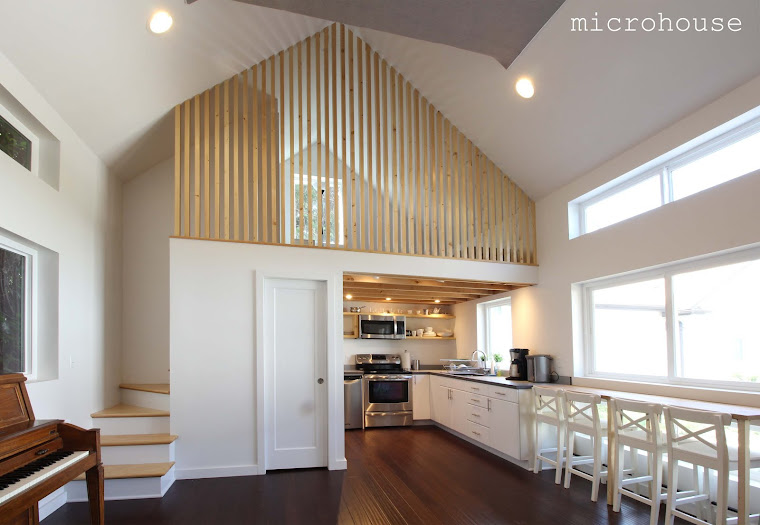
Vaulted ceilings make small rooms feel larger. The scissor truss design used is not only energy efficient, and affordable to build, but the simple gable form gave us an opportunity to play around with the overall style of the building.
A small eating nook adjacent to the kitchen.
Friday, November 9
drought tolerant plants:
saving water in style
A dry summer that saw record breaking heat and drought in much of the country has come to an end. Rain and cool weather have returned to in the Puget Sound. That means the beginning of planning and planting for the year ahead. With our summers predicted to be warmer and dryer, what can we do to create a yard that will look beautiful year round while saving water? The careful selection of native and drought tolerant
plants can result in a beautiful landscape that requires minimal maintenance
and water. Read on to learn more about
the use of these popular plants.
Native and Drought tolerant plants
Native plants are often a good choice for gardens as they are well adapted to your climate and available rainfall without the use of supplemental watering after they have been established. Their use has the added benefit of creating habitats that favor local birds and other wildlife. Lists of native plant species for your region are available from many sources one of the best of which is your local cooperative extension office. Local and nurseries are also a great place to see and learn about native plants.
Many Puget Sound natives are Drought-tolerant. That means they are resistant to seasonal periods of little or no rainfall. These plants come in an amazing variety and can be used to create lush landscapes. Here are some of our favorites.
Red Flowering Currant
Ribes sanguineum
USDA zones: 6 to 10
Water requirement:Moderate; tolerates some drought
Light requirement: Full sun or partial shade
Mature size: 6 to 12 feet high
Environmental benefits: Flowers in spring; fruit is attractive to birds
Native range: U.S. Pacific coast
Ribes sanguineum
USDA zones: 6 to 10
Water requirement:Moderate; tolerates some drought
Light requirement: Full sun or partial shade
Mature size: 6 to 12 feet high
Environmental benefits: Flowers in spring; fruit is attractive to birds
Native range: U.S. Pacific coast
Service Berry
Amelanchier alnifolia
USDA zones: 3 to 9
Water requirement: Has good drought resistance
Light requirement: Full sun
Mature size: 10 feet high
Environmental benefits: Nutritious fruit used fresh, frozen or processed. Wildlife value: high-quality cover and food. With a sweet nutty taste, the fruits have long been eaten by Canada's aboriginal people, fresh or dried.
Native range: Northwest and west U.S. and Canada
Amelanchier alnifolia
USDA zones: 3 to 9
Water requirement: Has good drought resistance
Light requirement: Full sun
Mature size: 10 feet high
Environmental benefits: Nutritious fruit used fresh, frozen or processed. Wildlife value: high-quality cover and food. With a sweet nutty taste, the fruits have long been eaten by Canada's aboriginal people, fresh or dried.
Native range: Northwest and west U.S. and Canada
Vine Maple
Acer circinatumUSDA zones: 4 to 8
Water requirement: Medium
Light requirement: Full to partial sun
Mature size: 15 feet
Environmental benefits: Vine maple flourishes as an understory tree in moist woods with dappled shade and along stream banks. In native stands, vine maple commonly occurs with bigleaf maple, Douglas fir, western hemlock, grand fir and Pacific dogwood, with sword fern underneath.
Native range: U.S. Pacific coast
Sword Fern
Polystichum munitum
USDA zone: 4a
Water requirement: Able to withstand dry summers but prefers cool-weather moist soil
Light reqirement: Shade or partial shade
Mature size: 3-foot by 3-foot spread
Soil type: Does best in organic soils but can stand the most acidic conditions
Environmental benefits: Western sword fern spores have many medicinal uses, including relieving the pain from the sting of a stinging nettle
Native range: U.S. Pacific coast
Many Mediterranean plants and drought tolerant and thrive in the Puget Sound region Lavender and Rosemary are two great choices.
Lavender
Lavandula
USDA zones: 5 to 9Water requirement:Drought tolerantLight requirement: Full to partial sunMature size: 2 feet high and wideEnvironmental benefits: Spring flowersNative range:Mediterranean
Lavandula
USDA zones: 5 to 9Water requirement:Drought tolerantLight requirement: Full to partial sunMature size: 2 feet high and wideEnvironmental benefits: Spring flowersNative range:Mediterranean
Subscribe to:
Posts (Atom)